Contact Info
- Lilongwe, Malawi
- +265 899 25 21 95 (Whatsapp)
- contact@webmobyle.com
- Working Days: Monday - Friday
Download Audio: From Manual Processes to Automation: When to Invest in a Web App
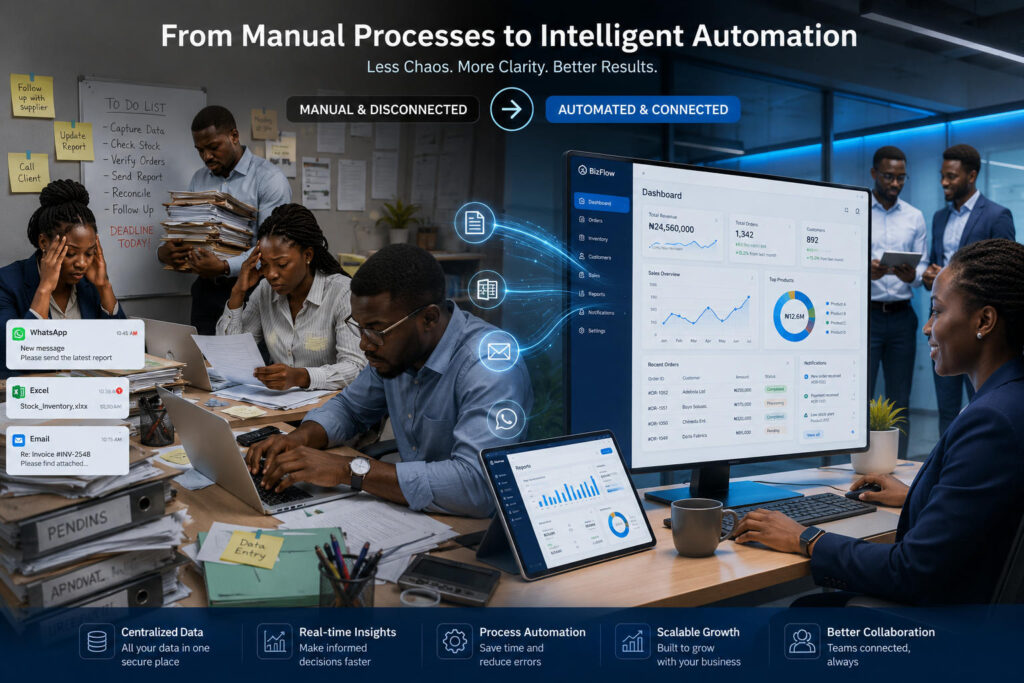
Many businesses begin with manual processes because they are simple, familiar, and cost-effective in the early stages. Spreadsheets, WhatsApp messages, phone calls, paper records, and email chains can work surprisingly well when operations are still small.
The challenge comes when the business starts growing.
What once felt manageable gradually becomes time-consuming. Staff spend hours repeating the same tasks, customer requests begin slipping through the cracks, and reporting becomes increasingly difficult. This is often the point where businesses begin considering automation through a custom web application.
Manual processes are everyday tasks that rely heavily on people rather than systems. Examples include:
Recording customer information in spreadsheets.
Scheduling appointments through phone calls or messaging apps.
Tracking inventory manually.
Sending invoices individually.
Managing approvals through long email conversations.
These methods are common because they are easy to start with. However, they can become a bottleneck as demand increases.
One of the biggest signs is repetition. If your team is entering the same information multiple times or performing the same tasks every day, automation can save significant time.
Another warning sign is when growth creates operational stress instead of efficiency. Hiring more staff just to keep up with repetitive administrative work is usually a sign that systems need improvement.
Customer experience is another important factor. Slow responses, missed follow-ups, delayed bookings, or misplaced information can affect trust and professionalism.
Finally, reporting should not take hours. If simple questions such as “How many sales did we make this month?” require digging through spreadsheets and messages, your business may already be ready for automation.
A web application can centralize information and streamline workflows across your business.
Depending on your needs, a web app can:
Automate bookings and appointments.
Manage customer records.
Track inventory and orders.
Generate invoices and reports.
Send automatic reminders and notifications.
Improve team collaboration.
Provide dashboards with real-time business insights.
Unlike a standard website, a web app is designed to support business operations internally while improving the customer experience externally.
Not every business needs a custom web app immediately.
If your processes are still changing rapidly, or if existing tools already solve the problem effectively, it may be better to wait. The best automation projects usually happen after a business clearly understands its workflows and bottlenecks.
Investing in a web app does not mean automating everything at once.
Many successful businesses begin by improving a single process first: such as bookings, invoicing, or customer management; and expand gradually over time.
The goal of automation is not simply to use technology. It is to reduce repetitive work, improve accuracy, save time, and create a stronger foundation for growth.
When manual processes begin slowing your business down instead of supporting it, that is often the right time to explore automation.
Want to hear some more from the Webmobyle Blog? Please
We use cookies to improve your experience on our site. By using our site, you consent to cookies.
Manage your cookie preferences below:
Essential cookies enable basic functions and are necessary for the proper function of the website.
These cookies are needed for adding comments on this website.
Statistics cookies collect information anonymously. This information helps us understand how visitors use our website.
Google Analytics is a powerful tool that tracks and analyzes website traffic for informed marketing decisions.
Service URL: policies.google.com (opens in a new window)
SourceBuster is used by WooCommerce for order attribution based on user source.
Marketing cookies are used to follow visitors to websites. The intention is to show ads that are relevant and engaging to the individual user.
Google Maps is a web mapping service providing satellite imagery, real-time navigation, and location-based information.
Service URL: policies.google.com (opens in a new window)

Leave A Comment