Contact Info
- Lilongwe, Malawi
- +265 899 25 21 95 (Whatsapp)
- contact@webmobyle.com
- Working Days: Monday - Friday
Download Audio: Market First, Product Second: How to Validate Before You Build
Most products don’t fail because they’re badly built.
They fail because nobody actually needed them.
By some estimates, well over half of new products never gain meaningful traction: not due to poor execution, but because they were built on assumptions rather than real demand.
Entrepreneurs often fall into the same trap: a clever idea sparks excitement, development begins immediately, and months later the product launches… to silence. Not because the execution was poor, but because the market was never validated.
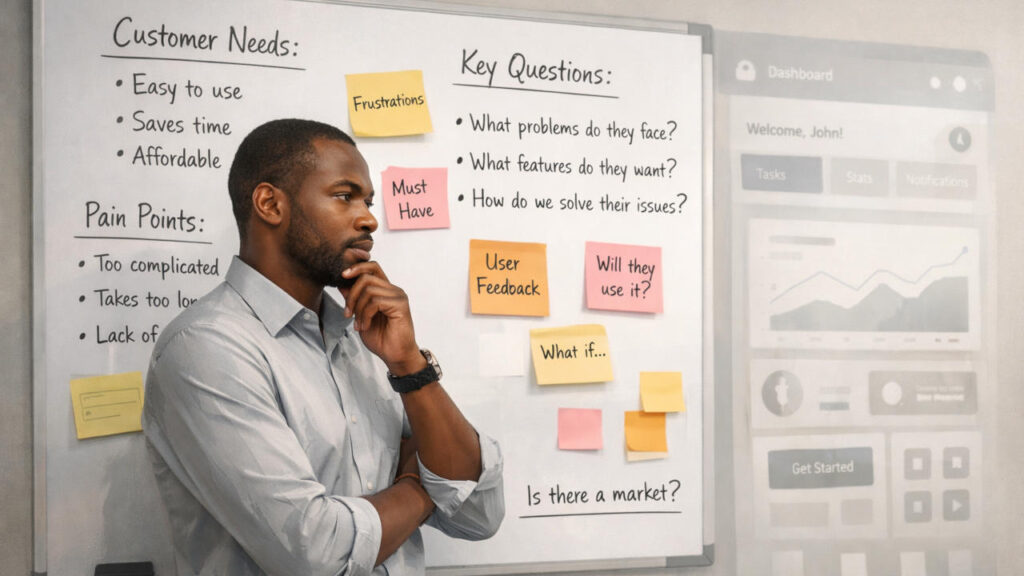
The smartest founders flip the order: market first, product second. This approach focuses on validating demand early, reducing risk, and building only what the market has already signaled it wants.
Building software, websites, or platforms is expensive: not just financially, but emotionally. Once you’ve invested time and effort, it becomes harder to listen objectively to feedback. You start defending the idea instead of questioning it.
A market-first mindset protects you from that. It forces you to replace assumptions with evidence and opinions with signals. Instead of asking, “Is my idea good?” you ask, “Is this problem painful enough that people are already trying to solve it?”
That shift changes everything.
Strong businesses are built around urgent problems. Not “nice-to-have” inconveniences, but recurring pains that cost people time, money, or peace of mind.
Imagine a founder who notices their own frustration managing appointments manually. Instead of jumping straight into building an app, they speak to others in the same role and discover the frustration is widespread; and costly. That’s where real opportunities live.
If a problem is real:
People complain about it unprompted
They’ve tried workarounds (even bad ones)
They’re already spending money or effort to reduce it
Ideas are cheap. Pain is valuable.
Trying to build for everyone usually means building for no one.
Clear validation requires a clearly defined customer: not just demographics, but context. What does a day in their life look like? What pressures are they under? What outcome are they actually trying to achieve?
The narrower your focus, the clearer the feedback.
Surveys often lie; not intentionally, but politely. People say they would use something. What matters is whether they already do something about the problem.
For example, instead of asking, “Would you use a tool like this?”, ask “How are you currently solving this problem?” or “What happens when this issue isn’t resolved?”
Have direct conversations. Ask about their current process. Ask what frustrates them. Ask what happens if the problem isn’t solved.
Listen more than you pitch.
You don’t need a finished product to validate demand. Simple tests work:
A landing page with a clear value proposition
A waitlist or email signup
A pre-order or paid pilot
A manual version of the solution
Money, time, and commitment are stronger signals than praise.
Validation isn’t about proving yourself right. It’s about learning fast.
If the signals are strong: build with confidence.
If they’re mixed: pivot.
If they’re weak: walk away early.
Stopping early is not failure. It’s discipline.
Building less and learning faster is a competitive advantage.
When you let the market lead, development becomes clearer, cheaper, and more focused. You don’t just build products: you build businesses that have already earned the right to exist.
If you’re working on an idea right now, take one small step this week to validate it. One conversation, one landing page, or one simple test can save you months of unnecessary work.
Want to hear some more from the Webmobyle Blog? Please
We use cookies to improve your experience on our site. By using our site, you consent to cookies.
Manage your cookie preferences below:
Essential cookies enable basic functions and are necessary for the proper function of the website.
These cookies are needed for adding comments on this website.
Statistics cookies collect information anonymously. This information helps us understand how visitors use our website.
Google Analytics is a powerful tool that tracks and analyzes website traffic for informed marketing decisions.
Service URL: policies.google.com
SourceBuster is used by WooCommerce for order attribution based on user source.
Marketing cookies are used to follow visitors to websites. The intention is to show ads that are relevant and engaging to the individual user.
Google Maps is a web mapping service providing satellite imagery, real-time navigation, and location-based information.
Service URL: policies.google.com

Leave A Comment